



Introduction
China, as the world’s largest manufacturer and exporter, ships billions of dollars worth of goods annually. From electronics and home appliances to industrial parts, apparel, and raw materials, this country offers an unparalleled variety of products to global importers. However, success in importing from China is not limited to finding a good product; choosing the right supplier is the main key to profitability and quality maintenance.
When it comes to sourcing, you have two main options:
Factory (Manufacturer): The production unit that makes the product directly.
Trading Company: An intermediary that sources goods from factories and supplies them to you.
Each of these options has its own pros and cons. A wrong choice can increase costs, lower quality, or prolong the sourcing process. For example, a factory usually offers a lower price but has a higher Minimum Order Quantity (MOQ), while trading companies offer more flexibility for small or diverse orders but charge a premium.
In this article from AloChina, we explore the differences between a Factory vs Trading Company in China step-by-step, explain how to identify them, and provide tips for selecting the best supplier for your business needs.
What is a Factory and Who is a Trading Company?
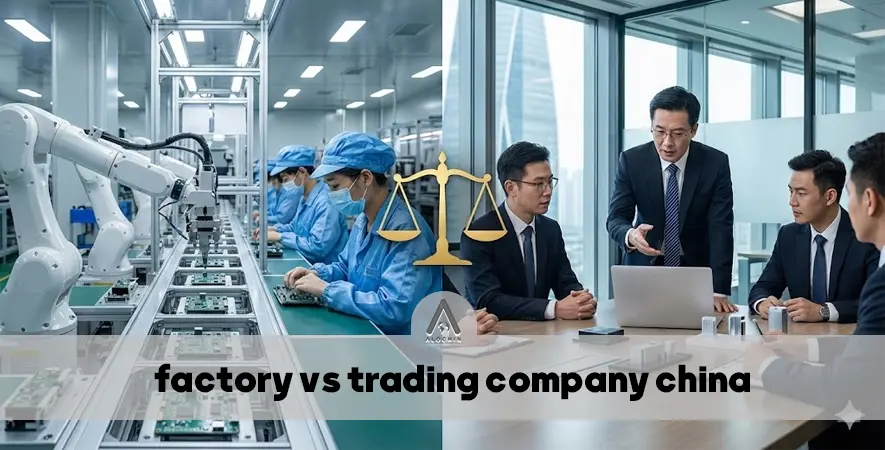
Factory (Manufacturer) A real production facility with equipment, assembly lines, and workforce that produces the product directly.
Trading Company An intermediary that has a network of factories and supplies diverse products without owning a production line.
Optimize Your Sourcing via UAE with AloChina
“Unsure whether to go direct to a factory or use a trader? Let AloChina bridge the gap. Operating from the global hub of Dubai, we act as your on-the-ground eyes in China. We can consolidate goods from multiple factories (acting like a premium trading partner) while securing direct factory prices. We handle the quality control in China and logistics to the UAE and beyond, ensuring you get the best of both worlds without the hassle.”
Comparison of Pros and Cons
To help you decide, here is a breakdown of the key differences:
Unit Price:
Factory: Lower (Direct source, no middleman margin).
Trading Company: Higher (Includes the middleman’s profit).
MOQ (Minimum Order Quantity):
Factory: Often High (Required to start production lines).
Trading Company: Lower (Suitable for small businesses).
Product Variety:
Factory: Limited to their specific specialization/niche.
Trading Company: Wide range (Can source from multiple factories).
Communication:
Factory: Often limited English skills; communication can be slow.
Trading Company: Usually fluent in English with professional sales teams.
Quality Control:
Factory: Direct and precise control over production.
Trading Company: Dependent on the supplying factory (less direct control).
How to Distinguish a Real Factory
Many trading companies claim to be factories. Here is how to spot the difference:
Check Business License: Look for the “Business Scope” section. Factories have words like “Manufacture” or “Production,” while traders have “Wholesale” or “Trade.”
Site Visit / Video Call: Factories usually have raw materials and machinery visible. If they resist a video call of the production line, be suspicious.
Product Range: If a supplier sells everything from phone cases to garden tools, they are likely a trading company.
MOQ & Price: If they offer a very low MOQ for a complex custom product, it’s a sign of a middleman.
Which Option is Better for You?
Small or Diverse Orders: Trading Company. Best for low MOQs and mixing different products in one container.
Large or Customized Orders (OEM): Factory. Best for lower prices on bulk orders and strict control over custom specifications.
Medium Orders: Consider “Hybrid” companies (Factories that have a trading department).
Checklist Before Choosing a Supplier
Verify the official business license and registration.
Get the exact factory address (and check it on maps).
Request a production sample.
Assess language skills and response speed.
Compare quotes and MOQs from multiple sources.
Analyze their export history.
Why Knowing This Difference Matters?
Choosing wrongly can increase your costs by 5–10% and cause quality issues. When an unnecessary middleman stands between you and the manufacturer for a bulk order, the risk of miscommunication and delay increases.
Conclusion
Choosing between a Factory vs Trading Company in China is one of the most important decisions any importer must make. Factories are ideal for large orders and direct quality control, while trading companies suit smaller, diverse, or trial orders. Understanding the exact pros and cons helps you make the best decision based on your business goals.
Don’t forget to always verify the official license, product samples, and communication quality before collaborating. Comparing prices and MOQs, and using professional inspection and sourcing services, reduces transaction risk. AloChina, with years of experience in sourcing from China, helps you select the best supplier, whether it’s a factory or a trading company. With a vast network of reliable partners, our team manages the selection, inspection, shipping, and clearance process so you can expand your trade with peace of mind.